



-
Becas y convocatorias
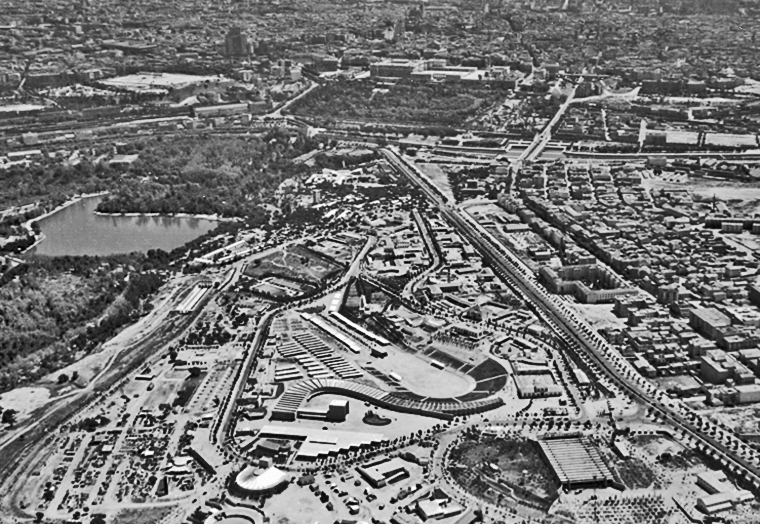
The subject of this thesis "The fair of the Casa de Campo in Madrid (1950-75)" is addressed from a perspective that alternates the overall view with a detailed vision. Starting with a research of the documentation and bibliography and a graphical restitution, we study in detail the comprehension of the relations of the fair with the rest of the city, from the originality and singularities of its design and the description and the analysis of its architectures.
We try to place the pavilions in the context of the architectures of the studied period. In the case of the original fair and the pavilions designed by the architect Francisco Cabrero, we indicate possible references to the vernacular and classic tradition, to the invariability of the traditional rules of the Spanish architecture, and to the contemporary vision of the modern architecture and his personal interpretation compiled in his Cuatro Libros de Arquitectura.
Another part of the work is dedicated to the rest of the pavilions that where build due to the needs of the organisms that participates in the fair. Depending on the different authors, some fundamental in the transition to modernity as Alejandro de la Sota, Miguel Fisac or Rafael Aburto, these pavilions make up a heterogeneous collection of different styles, functional and spatial conceptions, and architectural quality. From the comparison we extract the adequate reflections.
The fair supposes an alteration of the original place and had a big influence in the shape and the development of this urban area, and this influence still exists nowadays. We examine the consequences of the shape, the topography, the vegetation and the constructions. We also analyze the current character of the environment of the Manzanares river and its effect in the fair’s structure that is divided into two pieces with different architectures, the old part and the new part. We start from a graphical and chronological restitution, with different degrees of detail, of the whole fair and the selected pavilions.
Other reflections focus on the role of the commissioner and the chief architects. We study the evolution of the fair from the original project with its conditions, and the extension of the fair and the management of the evolution of the fair based on the agricultural, folkloric, commercial, industrial and tourist requirements. We see an architecture that it characterized by the capacity to improvise, the flexibility, and the ability to take advantage of each particular situation.
The work concentrates on about 40 pavilions and stands (the third part of those that were constructed). This supposes a choice on the basis of criteria of quality and opportunity. The selected pavilions are milestones or examples of the different trends that we classify in popular and modern, almost, as a pre-established conclusion. The work is directed towards the modern buildings, either because of their degree of assimilation of the modern ideal, their degree of experimentation and technical innovation, or their significance in the configuration of exhibition spaces. Currently, the popular pavilions are more and better preserved, what gives a special value to the modern ones. However, the popular pavilions have also their special interest. They may be studied in more detail in posterior research works that can relay on the compiled material in this thesis.
The fundamental aim of this research has been to know in depth the architecture of the representative pavilions of every period. We tried to understand the design processes of these pavilions from different perspectives that include all the disciplines that come together in the architectural project. The thesis offers the written and drawn restitution of the fair and its architectures and provides an interpretation and evaluation of its author.
Alejandro de la Sota's contemporary vision with his architectural critique of the first fair, the constants exposed by Fernando Chueca, and the “sesiones críticas” of the Revista Nacional, indicate the way the different authors of the pavilions followed, and they allow us to establish a diagnosis of the ideas of the moment. Furthermore, we also analyze the relationships among the small circle of authors, the new trends and the influence of other plastic artists, like Carlos Pascual de Lara, Joaquin Vaquero or Amadeo Gabino.
Finally, the documentation and analysis of audiovisual material, news, magazines and leaflets of the Feria del Campo, allow to extract conclusions on the originality of the design of the fair and the pavilions, and also of its use, operation and social acceptance, from the perspective of the political and cultural evolution until the democratic transition.
The abundant administrative material that has been found, allows us to conclude on the veracity of the circumstances that influenced the conception and development of the fair and its buildings, and confirms the testimony of the involved protagonists.
El tema objeto de investigación "El recinto ferial de la Casa de Campo de Madrid (1950-75)" se trata desde una perspectiva que alterna la visión general y la visión pormenorizada. Profundizamos en la comprensión de las relaciones del recinto con el resto de la ciudad, desde la originalidad y singularidad de su trazado, la descripción y el análisis con distinto grado de detalle de sus arquitecturas, a partir, de la investigación documental, bibliográfica y la restitución gráfica realizada.
Procuramos situar los pabellones en el contexto de las arquitecturas del periodo estudiado, indicando, en el caso del recinto original y los pabellones proyectados por el arquitecto Francisco Cabrero, posibles referencias a la tradición vernácula y clásica, los invariantes de la arquitectura española, sus maestros, la visión contemporánea de la arquitectura moderna e interpretación personal, recogida en sus Cuatro Libros de Arquitectura.
Otro campo de estudio, el resto de los pabellones construidos en virtud de las necesidades de los organismos que concurrían a la feria, constituyeron, dependiendo de sus distintos autores, algunos fundamentales en la transición hacia la modernidad como Alejandro de la Sota, Miguel Fisac o Rafael Aburto, un conjunto heterogéneo y diverso de planteamientos estilísticos, concepciones funcionales, espaciales y de calidad arquitectónica. De la comparación se extraen las oportunas reflexiones.
La feria supone una alteración de las preexistencias del lugar, influyendo decisivamente en la configuración y evolución del ámbito urbano, condicionándolo, también hoy en día. Examinaremos la repercusión del trazado, la topografía, la vegetación y las construcciones. El carácter actual de cuña dotacional en el entorno del río Manzanares y la repercusión en la estructura del recinto de su división en dos piezas de arquitecturas tan distintas, como la parte antigua y la parte nueva. Partiremos de una restitución gráfica y cronológica, con distinto grado de detalle, del conjunto y los pabellones seleccionados.
Otras reflexiones se centraran en el papel del comisario y los arquitectos directores. Desde los condicionantes del encargo inicial, la ampliación del recinto y la gestión de la evolución de la feria en base a los requerimientos agrícolas, folclóricos, comerciales, industriales y turísticos. Una arquitectura que nace de capacidad de improvisar, la flexibilidad, la habilidad y el provecho de cada situación particular.
La concreción en unos 40 pabellones y stands (una tercera parte de los que se construyeron), supone una elección en base a criterios de calidad y oportunidad. Son hitos o ejemplos de las distintas corrientes que clasificamos en populares y modernos, casi, como una conclusión preestablecida. El trabajo se orienta hacia las edificaciones modernas ya sea por su logro en la asimilación del ideal, su grado de experimentación e innovación técnica o su interés en la configuración de sus espacios expositivos. Se conservan más y mejor los pabellones populares, lo que nos obliga a la puesta en valor de los modernos, sin menospreciar el interés de los populares, que deberán estudiarse con mayor detalle en trabajos posteriores, a partir, del abundante material recopilado.
El objetivo fundamental del trabajo ha sido conocer en profundidad la arquitectura de los pabellones representativos de cada periodo, intentando comprender y restituir el proceso proyectual desde una visión múltiple que comprenda las disciplinas que confluyen en el proyecto arquitectónico. La tesis ofrece la restitución escrita y dibujada del recinto y sus arquitecturas, además, de la interpretación y valoración del autor.
La visión contemporánea de Alejandro de la Sota con su crítica arquitectónica de la primera feria, los invariantes expuestos por Fernando Chueca o las sesiones de crítica celebradas en la Revista Nacional, indican el camino que siguieron los autores de los pabellones de la feria y permiten profundizar en el diagnóstico de las ideas del momento, también, a partir de algunas entrevistas realizadas. Se estudian además las relaciones entre el estrecho círculo de autores, las nuevas tendencias y la influencia otros artistas plásticos como Carlos Pascual de Lara, Joaquín Vaquero o Amadeo Gabino.
Finalmente, la documentación y análisis del material audiovisual, los noticieros, revistas y boletines de la Feria del Campo, permiten extraer conclusiones sobre la originalidad del trazado del recinto y los pabellones, su utilización, así como, el funcionamiento y aceptación social de la feria, desde la perspectiva de la apertura y evolución política y cultural de la transición hacia la democracia.
La abundante documentación administrativa localizada admite concluir sobre la veracidad de las circunstancias que influyeron en la concepción y desarrollo del recinto y sus edificios, contrastando el testimonio de sus protagonistas a partir de la recreación propuesta.