



-
Becas y convocatorias
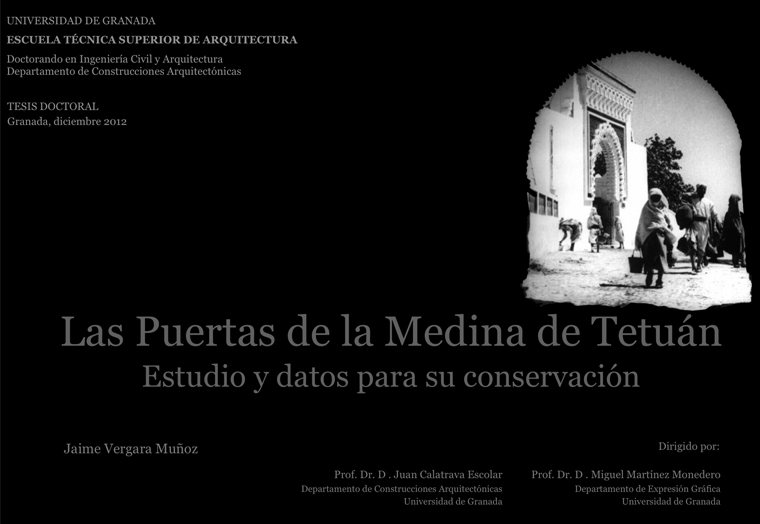
The city of Tetouan has one of the most interesting Islamic medinas in northern Morocco. It owns a popular architecture which constitutes an absorbing cultural heritage. This research work provides a comprehensive study about the Gates of Medina.
Its purpose is not only to awake the interest towards these elements – the Gates of Medina -, that they undoubtfully provoke, but to show an specific example of how architecture, even though looking forgotten or found too common, can get to have an interesting patrimonial value which must be studied, restored and preserved.
The present study is approached from two points of view:
- The diachronic one, in which a chronological track is made, of both the growth of the city and the appearance of its gates. In order to do this the study uses a historical analysis from Arabic, Spanish and Portuguese sources; as well as an urban evolution work about the Medina of Tetouan, with the help of local cartography, and a study on the literature works (from explorers and geographers) in which the medina and its gates and walls are described.
- The synchronic one, which explains the typological and morphological aspects and even counts on a taxonomic analysis of some of the elements. The research work provides a complete study for each Gate: A graphical tab about its raising, an architectural description, photographic material, etc…
The source provided to write the Doctoral Thesis comes from a personal file we came across during the elaboration: the file of Alfonso de Sierra Ochoa (town architect of Tetouan between 1945-1948 and 1955-1956).
Within that time, the Spanish Protectorate in Morocco carried out an important catalogue and study work of the main monuments in Northern Morocco. The file remained untouched until now. Only the Architecture School’s Library in Barcelona and the Spanish National Library held part of this material which Alfonso de Sierra Ochoa had bequeathed to these institutions before his demise.
With this unseen material, the Thesis focuses on this interesting period, the Protectorate of Morocco, and provides a reflection on Patrimonial protection during those years of Spanish domination. Was there concern about cultural heritage conservation during the years of the Protectorate?
After the studies and analyses, many a conclusion have been set, but the main idea is that these so modest edifications, not lacking architectural value, raised by the people , have an indefinite style because of the patches, additions and modifications added to them, even though the “Almohad” and the “Hispanic-Maghreb” style predominate. The constructions were carried out by builders who, having witnessed the “great architecture –– so called for being built by masters and with quality materials –– in other places, interpreted that way of building in their own way when they reached their destination, taking use of the poor materials they had. Their purpose was not to make monumental architecture, but constructions as useful, functional and beautiful as possible.
La ciudad de Tetuán cuenta con una de las medinas islámicas más interesantes del norte de Marruecos. Posee una arquitectura popular que constituye un interesante patrimonio cultural. El trabajo de investigación aporta un completo estudio sobre las Puertas de la Medina.
La intención no es únicamente despertar el interés sobre estos elementos —las Puertas de la Medina―, que sin duda lo tienen, sino descubrir un ejemplo concreto que nos muestra cómo la arquitectura, por olvidada que parezca o por común que nos resulte, puede llegar a tener un interesante valor patrimonial que se debe estudiar, restaurar y conservar.
Se enfoca dicho estudio desde dos vertientes:
-la diacrónica, en la que se hace un seguimiento cronológico, tanto del crecimiento de la ciudad, como de la aparición de sus puertas. Se emplea el análisis histórico a través de fuentes árabes, españolas y portuguesas; una evolución urbana de la medina de Tetuán a través de la cartografía y un estudio de la literatura (exploradores y geógrafos) donde se describe la Medina con sus puertas y murallas.
-la sincrónica, que trata los aspectos tipológicos, morfológicos e, incluso, del análisis taxonómico de algunos de los elementos. Se proporciona de cada Puerta un completo estudio: ficha gráfica con los levantamientos, descripción arquitectónica, material fotográfico, etc.
El material que se empleó para redactar la Tesis Doctoral procede de un archivo personal que encontramos durante la elaboración de la Tesis: El archivo de Alfonso de Sierra Ochoa (arquitecto municipal de Tetuán entre 1945 a 1948 y de 1955 a 1956).
Durante esos años —Protectorado Español en Marruecos― realizó una importante labor de catalogación y estudio de los principales monumentos del Norte de Marruecos. El archivo permanecía hasta ahora, inédito. Tan sólo en la Biblioteca de la Escuela Técnica de Barcelona y en la Biblioteca Nacional, poseían parte de ese material que legó a esas instituciones antes de su fallecimiento.
Con este material inédito, la Tesis se detiene en este interesante periodo —el Protectorado― y proporciona una reflexión sobre la protección del Patrimonio durante esos años de dominación española ¿Existió preocupación por la conservación del Patrimonio durante los años del Protectorado?
Tras los estudios y análisis se llega a la conclusión, entre otras, de que estas modestísimas construcciones, no carentes de valor arquitectónico, surgidas del pueblo, son de estilo indefinido, por los remiendos, añadidos y modificaciones sufridas, pero predominando el “almohade” y el “hispano-magrebí”. Ejecutados por los constructores que vieron, en otros lugares, “la gran arquitectura”, la hecha por los maestros, levantada con materiales nobles, y cuando llegaron a su destino, la interpretaron “a su aire” y con los pobres materiales de que disponían. Sin pretender hacer arquitectura monumental, sino utilitaria, funcional y lo más bella posible.