




-
Becas y convocatorias
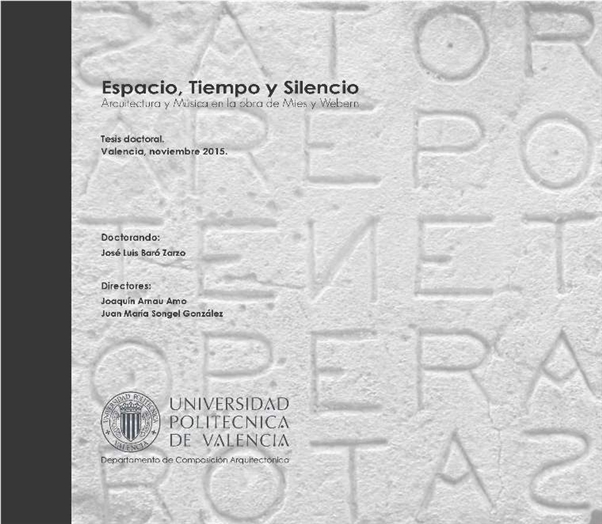
El estudio pretende ahondar en el terreno en que la Arquitectura y la Música confluyen entendidas como disciplinas artísticas, esto es, desde su capacidad creativa para expresar ideas o emociones con una finalidad estética. Es cierto que una y otra se desenvuelve en medios diferentes. El carácter estático de la Arquitectura resulta más evidente cuando se la compara con la Música: la arquitectura es una música congelada, decía Schopenhauer. Pero estas obvias diferencias no impiden rastrear entre las múltiples afinidades. A lo largo de la historia, filósofos, poetas, músicos y arquitectos se han pronunciado al respecto.
Pero abordar las analogías músico-arquitectónicas de forma genérica, sin más precisiones, resulta absolutamente inalcanzable. Además, se corre el riesgo de caer con demasiada facilidad en divagaciones o incluso de llegar a conclusiones sustentadas en meras opiniones. Es por ello que se ha querido acotar el objeto de estudio lo suficiente como para poder tratarlo con la intensidad que se requiere. Por una parte, ciñéndolo a un período histórico que comprende las primeras décadas del siglo XX, momento extraordinariamente efervescente para las artes, abanderadas por las corrientes pictóricas de vanguardia. Por otra, localizándolo en un espectro geográfico en torno a dos metrópolis germánicas, importantes centros de intercambio artístico y cultural de la época: Berlín y Viena. Asimismo, se ha elegido un representante de cada disciplina como referente para el análisis comparativo de obras concretas: el arquitecto alemán Ludwig Mies van der Rohe (1886-1969) y el compositor vienés Anton Webern (1883-1945).
Conviene aclarar que no es objetivo de esta tesis el estudio exhaustivo de la producción de los actores citados, ya de por sí ampliamente tratada por los expertos en innumerables publicaciones desde mediados de los cincuenta respondiendo al prestigio universal de su obra, sino en la medida en que ambos repertorios ofrecen paralelismos. La idea de abstracción, la voluntaria limitación de recursos, el cromatismo, la equidistante evolución de sus trayectorias creativas, etc... están lejos de ser simples coincidencias. En definitiva, interesa no tanto la profundidad sino la transversalidad, no la línea recta sino la oblicua.
Definido este enfoque, se suscitan al instante multitud de cruces de influencias en una y otra dirección. Kandinsky y Schoenberg entablaron una relación que no resulta ajena a la irrupción de la abstracción en la pintura y en la música; tanto ellos como Paul Klee, que también era músico, se mostraron activos alrededor del movimiento expresionista Der Blaue Reiter. Por su parte, Adolf Loos coqueteó con diversas corrientes pictóricas y ofreció protección hacia una incomprendida música atonal que Arnold Schoenberg –quien también había tenido escarceos con la pintura– y sus discípulos Berg y Webern comenzaban a componer. Más tarde, Walter Gropius se convertía en el segundo marido de Alma Mahler, compositora y viuda del gran Gustav Mahler. A su vez, desde la Bauhaus, con quien no se llevaba bien Loos, se canalizaron las sinergias hacia la producción industrial y la arquitectura, a cuyo fin pondría un mayor énfasis su último director, Ludwig Mies van der Rohe.
La conexión que lleva de Webern a Mies no representa, pues, un hilo directo. De hecho, no existe constancia de que se conocieran personalmente, ni de que revelasen algún tipo de admiración el uno por el otro. Tampoco se han encontrado declaraciones o comentarios en los que Mies exprese sus preferencias musicales, ni manifestaciones de Webern acerca de aspectos relacionados con la arquitectura. Ambos se consideraban ante todo profesionales, apasionados por su trabajo, pero no precisamente intelectuales. Serían otros quienes desempeñasen mejor esa polivalencia, acompañada de grandes dotes comunicativas, caso de Schoenberg, de Loos o de Le Corbusier.
Lo que se pretende demostrar es cómo el sustrato filosófico y estético del momento, los avances científicos y tecnológicos, el ambiente cultural y artístico, en fin, el espíritu de la época en el mundo germánico, constituyen el caldo de cultivo que propicia la confluencia de planteamientos compositivos, aun desde disciplinas artísticas a priori tan diferentes.
Para llegar a dichas conclusiones se han desentrañado a partir del riguroso análisis de sus obras aquellos conceptos compartidos, como el ritmo y la armonía, ideas como la concentración y la esencialidad, metodologías como el dodecafonismo o el orden industrial, posturas como la libertad y el perfeccionismo, enfoques como la forma y la función...
En última instancia el estudio no se propone sino indagar acerca de la visión de la Música desde la perspectiva del arquitecto, y viceversa, cómo se percibe la Arquitectura a los ojos de un músico o de un compositor.
The present study aims to go in depth into the field where Architecture and Music converge, both of them understood as artistic disciplines, that is, from their creative capacity to express ideas or emotions with an aesthetic purpose. It is true that each of them develops in different ways. The static aspect of Architecture is more evident when we compare it with Music: according to Schopenhauer, Architecture is like frozen music. But these conspicuous differences do not prevent us from tracking into their multiple affinities. Along history, philosophers, poets, musicians and architects have said something about it.
But approaching these “Music-Architecture” analogies from a generic point of view, without more precisions, becomes absolutely unattainable. Besides, there is a risk of starting digressing easily or even reaching conclusions based on mere opinions. This has been the reason to delimit enough the object of this study, so that it can be treated properly. On the one hand, it has been delimited to a historical period covering the first decades of the 20th century, an extraordinarily exciting moment for the arts, whose standard were the avant-garde pictorial movements. On the other hand, it has been located within a geographical area covering two Germanic metropolis that were important centres of cultural and artistic exchange at that time: Berlin and Vienna. In the same way, a representative of each discipline has been chosen as a referent for the comparative analysis of concrete works: the German architect Ludwig Mies van der Rohe (1886-1969) and the Viennese composer Anton Webern (1883-1945).
It is important to clarify that the objective of this thesis is not a comprehensive study of the output of the aforementioned artists, which has already been widely treated by experts in a number of other publications since the mid-fifties and attending to the universal prestige of their production. What will be treated here is the way in which both repertoires offer parallelisms. The idea of abstraction, the intentional limitation of resources, chromatism, the equidistant evolution of their artistic careers, etc… which are far from being simple coincidences. In short, the most interesting aspect is the transversality rather than the depth, the oblique line rather than the straight.
Having defined the scope of the study, there instantly appear multitude of intersections and influences in one direction or the other. Kandinsky and Schoenberg established a relationship that was not unrelated to the sudden arrival of abstraction in painting and music. These two artists together with Paul Klee, who was also a musician, were very active in the expressionistic movement called Der Blaue Reiter. Adolf Loos was also involved in diverse pictorial trends and offered protection to a misunderstood atonal music that Arnold Schoenberg –who had also been involved with painting– and his disciples Berg and Webern were starting to compose. Later on, Walter Gropius would become Alma Mahler’s second husband. Alma was a composer and also the widow of the great Gustav Mahler. Simultaneously, in the Bauhaus –which Loos did not have a good relationship with– there was a synergism that stimulated the industrial and architectural production, promoted with great emphasis by its last director, Ludwig Mies van der Rohe.
What connects Webern and Mies is therefore not represented by a direct link. In fact, there is no evidence that they met personally, neither that there was any type of admiration of one another. Declarations or comments in which Mies expresses his musical preferences or comments in which Webern expresses aspects related to architecture have not been found. Both of them considered themselves as professional artists and were also fully passionate about their work but were not precisely intellectuals. There were others who performed better this versatility and great ability for communication; this is the case of Schoenberg, Loos or Le Corbusier.
What this study aims to demonstrate is how the philosophical and aesthetic currents of the moment, the scientific and technological advances, the cultural and artistic environment and the spirit of the time in the Germanic world constituted the breeding ground that promoted the convergence of compositional approaches, even from artistic disciplines that a priori seem so different.
To reach these conclusions, there has been a rigorous analysis of the artists’ output in order to unravel the concepts they share and have in common such as rhythm and harmony, ideas such as concentration and essentiality, methodologies such as dodecaphonism or the industrial order, postures such as liberty and perfectionism and scopes such as form and function…
As a last resort, the purpose of this study is to enquire into the vision of Music from the architect’s perspective and vice versa, that is, how Architecture is perceived in the eyes of a musician or a composer.

Arquitecto
E.T.S. A - València - UPV
VALENCIA | ESPAÑA